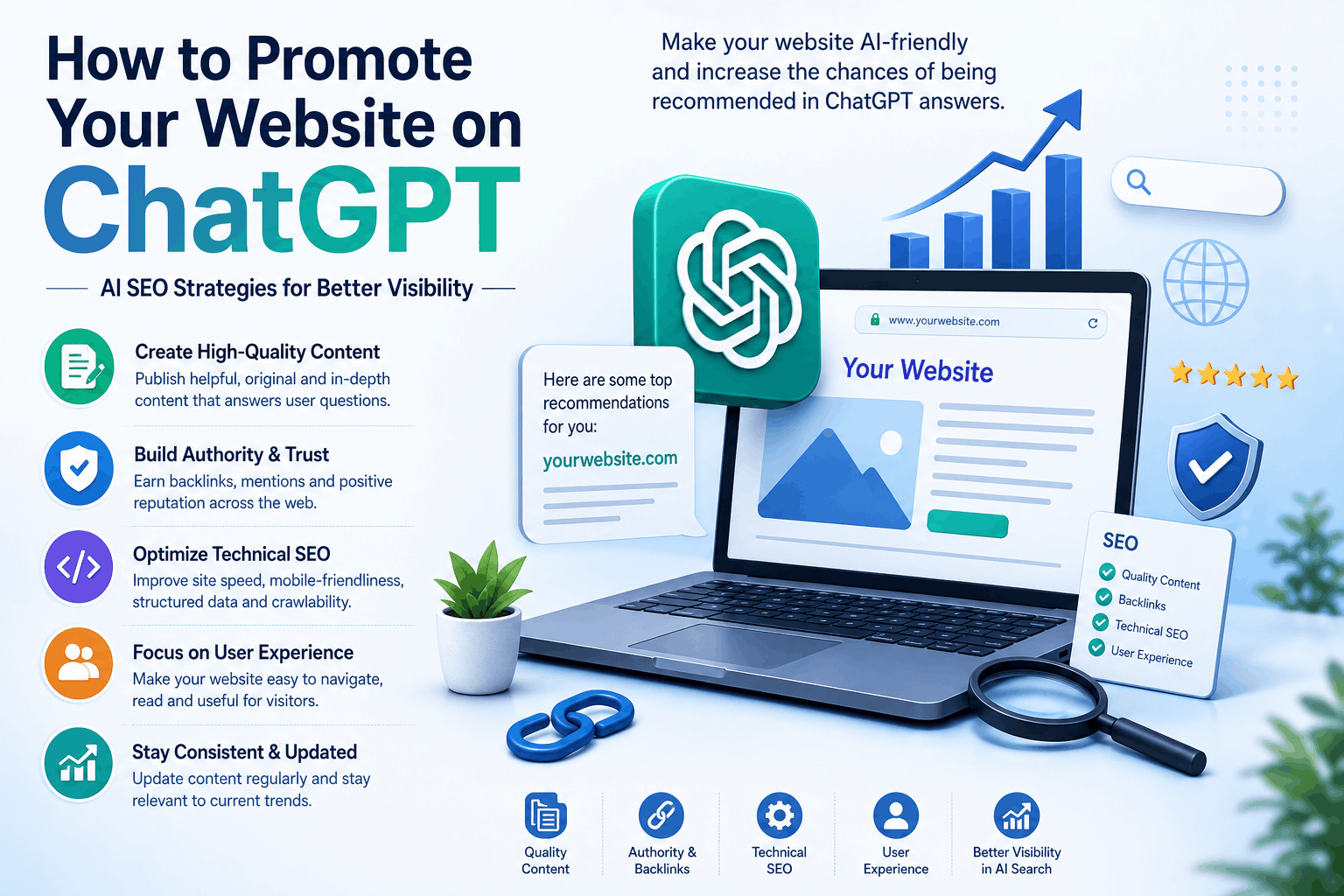
Artificial Intelligence is changing the way people search for information online. Instead of relying only on traditional search engines like Google, users are increasingly asking questions directly to AI-powered platforms such as ChatGPT. Whether they are looking for the best SEO company, a reliable real estate website, or answers to technical questions, AI assistants are becoming a trusted source of information.
This shift has introduced a new concept known as AI Search Optimization or Generative Engine Optimization (GEO). Unlike traditional SEO, where the goal is to rank higher in search engine results, AI optimization focuses on making your website trustworthy, authoritative, and easy for AI models to understand and reference.
If you’re wondering how to promote your website on ChatGPT, the answer isn’t about buying ads or submitting your website to OpenAI. Instead, it’s about building a high-quality online presence that AI systems recognize as reliable. In this guide, we’ll explain exactly how ChatGPT selects information and what you can do to increase your website’s visibility in AI-generated responses.
Can You Promote Your Website on ChatGPT?
The simple answer is yes—but not in the traditional sense.
Unlike search engines that display advertisements or sponsored listings, ChatGPT doesn’t offer paid placements for websites. There is currently no feature that allows businesses to pay to appear in ChatGPT’s responses.
Instead, ChatGPT relies on trusted information sources, authoritative websites, publicly available content, and high-quality web pages when generating responses. This means your website earns visibility by demonstrating expertise, credibility, and usefulness rather than through advertising.
The focus should be on creating content that answers users’ questions better than anyone else while ensuring your website follows strong SEO and technical best practices.
Understanding How ChatGPT Finds Website Information
To optimize your website effectively, it’s important to understand how AI assistants gather and evaluate information.
AI models don’t simply copy one webpage. Instead, they identify reliable patterns across multiple trustworthy sources. Websites that consistently publish accurate, well-structured, and authoritative content are more likely to influence AI-generated responses.
Several factors contribute to this process:
- Website authority
- Content quality
- Topical expertise
- Structured information
- User engagement
- Brand recognition
- Technical optimization
- Fresh and updated content
The stronger your digital reputation, the higher your chances of becoming a trusted source.
Why AI Search Optimization Matters
Search behavior is evolving rapidly.
Instead of typing:
Users are now asking:
“Which SEO company in Jaipur offers affordable SEO services for small businesses?”
AI platforms generate direct answers rather than displaying a list of links.
Businesses that prepare for AI-powered search today will gain a significant advantage over competitors relying solely on traditional SEO strategies.
AI optimization complements traditional SEO rather than replacing it.
Build High-Quality, Helpful Content
Content remains the foundation of visibility in both Google and AI search.
Every article should solve a specific problem instead of focusing only on keywords.
Good AI-friendly content includes:
- Detailed explanations
- Real examples
- Actionable advice
- Updated information
- Expert insights
- Clear structure
- Natural language
Instead of writing only promotional pages, publish educational resources that genuinely help readers.
For example, if you run an SEO agency, create articles explaining:
- Technical SEO
- Local SEO
- Website optimization
- SEO pricing
- Keyword research
- Google Search Console
- Core Web Vitals
- AI SEO
Helpful content naturally attracts backlinks, shares, and citations.
Focus on Topical Authority
One article is rarely enough.
AI prefers websites that demonstrate deep expertise within a subject.
For example, instead of publishing only one article about SEO, build a complete knowledge hub covering topics such as:
- On-page SEO
- Off-page SEO
- Technical SEO
- Local SEO
- Link building
- Website speed optimization
- Schema markup
- Content marketing
- AI SEO
- GEO optimization
- E-commerce SEO
The more comprehensive your coverage, the stronger your authority becomes.
Create Content That Answers Questions
AI assistants are designed to answer questions.
Instead of optimizing only for short keywords, write content that addresses complete user queries.
Examples include:
- How long does SEO take?
- What is AI SEO?
- Is ChatGPT replacing Google?
- How can small businesses rank online?
- What is GEO optimization?
- How does local SEO work?
- How do backlinks improve rankings?
When your content directly answers real questions, it becomes more useful for both readers and AI systems.
Write in Natural Language
Keyword stuffing is no longer effective.
AI systems understand context, meaning, and relationships between topics.
Instead of repeating the same keyword dozens of times, use conversational language that sounds natural while still covering relevant concepts.
Well-written content improves readability, engagement, and overall quality.
Improve Your Website’s Technical SEO
Technical optimization helps search engines and AI systems access and understand your content efficiently.
Key areas include:
Fast Website Speed
Slow websites create poor user experiences.
Compress images, reduce unnecessary scripts, enable caching, and improve server performance.
Mobile-Friendly Design
Most visitors now browse from mobile devices.
Responsive websites perform better across all platforms.
Secure HTTPS
Security builds trust with both users and search engines.
Always use SSL certificates.
XML Sitemap
A sitemap helps search engines discover your pages quickly.
Robots.txt
Ensure important pages are crawlable while blocking unnecessary areas.
Clean URL Structure
Use descriptive URLs.
Example:
oneseo.in/blog/how-to-promote-your-website-on-chatgpt
instead of
yourwebsite.com/page?id=12345
Use Structured Data (Schema Markup)
Schema markup provides additional context about your content.
Useful schema types include:
- Article
- Organization
- Local Business
- FAQ
- Breadcrumb
- Review
- Service
Structured data helps search engines better understand your website and may improve visibility across various search experiences.
Demonstrate Experience, Expertise, Authority, and Trust (E-E-A-T)
Google emphasizes Experience, Expertise, Authoritativeness, and Trustworthiness (E-E-A-T), and these qualities also align well with AI systems that prioritize reliable information.
Strengthen your E-E-A-T by:
- Publishing content written or reviewed by knowledgeable professionals.
- Including clear author information where appropriate.
- Citing credible sources for statistics and factual claims.
- Keeping articles updated.
- Displaying accurate business information, contact details, and policies.
Trust is built over time through consistent, accurate content.
Earn High-Quality Backlinks
Backlinks remain one of the strongest indicators of authority.
Focus on earning links from:
- Industry blogs
- News websites
- Business directories
- Educational institutions
- Professional associations
- Relevant partner websites
Avoid spammy link-building practices. A handful of high-quality backlinks is often more valuable than hundreds of low-quality ones.
Build a Recognizable Brand
Strong brands are more likely to be mentioned across the web.
Increase your brand visibility through:
- Thought leadership articles
- Guest blogging
- Industry events
- Podcasts
- Webinars
- Social media engagement
- Case studies
- Customer success stories
Brand recognition contributes to long-term authority.
Keep Your Content Updated
AI and search engines both favor fresh, accurate information.
Review your most important pages regularly to:
- Update outdated statistics.
- Add new examples.
- Refresh screenshots.
- Expand FAQs.
- Improve readability.
- Address new trends.
An article that is maintained over time is more useful than one that is published and forgotten.
Optimize for User Experience
Visitors should be able to find answers quickly.
Good user experience includes:
- Clear headings
- Short paragraphs
- Bullet points where appropriate
- Internal links to related topics
- Fast loading pages
- Easy navigation
- Readable typography
A positive user experience encourages visitors to spend more time on your website and explore additional content.
Create Helpful FAQs
Frequently Asked Questions help cover additional search intents and provide concise answers that are useful to both users and AI systems.
Examples include:
- Can I advertise directly on ChatGPT?
- Is AI SEO different from traditional SEO?
- Does ChatGPT use Google rankings?
- What is Generative Engine Optimization?
- How often should I update my website?
Adding FAQ schema to these sections can further enhance discoverability.
Traditional SEO vs AI Search Optimization
| Traditional SEO | AI Search Optimization |
|---|---|
| Focuses on search engine rankings | Focuses on being referenced in AI-generated answers |
| Targets keyword rankings | Targets comprehensive topic coverage |
| Measures clicks and rankings | Measures authority, trust, and usefulness |
| Relies heavily on SERPs | Adapts to conversational AI experiences |
| Optimizes for search engines | Optimizes for both humans and AI systems |
Rather than replacing SEO, AI search optimization builds on strong SEO fundamentals.
Common Mistakes to Avoid
Many website owners make mistakes that reduce their visibility.
Avoid:
- Publishing thin or duplicate content.
- Stuffing keywords unnaturally.
- Ignoring technical SEO.
- Using clickbait headlines that don’t deliver value.
- Neglecting content updates.
- Building low-quality backlinks.
- Copying AI-generated text without editing or adding expertise.
- Failing to establish topical authority.
Quality and consistency are far more effective than shortcuts.
AI SEO Checklist
Before publishing any article, make sure it meets these standards:
- Unique and original content
- Helpful, user-focused information
- Clear heading structure
- Mobile-friendly layout
- Fast loading speed
- HTTPS enabled
- Internal links to related content
- External references to reputable sources when appropriate
- Schema markup implemented
- Updated and accurate information
- Natural language and readability
- Strong calls to action where relevant
Using this checklist consistently can improve the overall quality of your website.
The Future of Website Promotion in AI Search
As AI assistants become a primary way people discover information, businesses will need to adapt their digital marketing strategies.
Future success will depend less on simply ranking for keywords and more on building genuine authority, publishing trustworthy content, and providing exceptional user experiences.
Businesses that invest in AI-friendly content today will be better positioned as AI-powered search continues to evolve.
How One SEO Can Help Your Business
Optimizing a website for both traditional search engines and AI-driven search requires a strategic approach. At One SEO, we help businesses improve their online visibility through comprehensive SEO services that align with modern search trends.
Our expertise includes:
- On-page SEO optimization
- Technical SEO audits
- Local SEO strategies
- Content marketing
- Keyword research
- Website speed optimization
- Schema markup implementation
- AI Search Optimization (GEO)
- Link-building strategies
- SEO consulting and performance tracking
Whether you’re a startup, local business, or established brand, we can help you build a stronger online presence for both Google and AI-powered search platforms.
Promoting your website on ChatGPT isn’t about paying for placement or finding a shortcut. It’s about creating a website that consistently demonstrates expertise, authority, and trust. By publishing valuable content, improving technical SEO, building topical authority, earning high-quality backlinks, and maintaining a strong user experience, you increase the likelihood that your content will be recognized across modern AI-driven search experiences.
As search continues to evolve, businesses that embrace AI Search Optimization (GEO) alongside traditional SEO will be better prepared for the future. Start investing in high-quality, user-focused content today, and you’ll be building a stronger digital presence that benefits both your audience and your long-term growth.
Frequently Asked Questions (FAQs)
1. Can I pay to promote my website on ChatGPT?
No. ChatGPT does not offer paid advertising or sponsored placements. Visibility comes from creating authoritative, trustworthy, and helpful content.
2. What is AI Search Optimization (GEO)?
Generative Engine Optimization (GEO) is the practice of optimizing your website so AI-powered search tools can better understand, trust, and reference your content.
3. Does traditional SEO still matter?
Absolutely. Strong technical SEO, high-quality content, and authoritative backlinks remain the foundation for visibility in both search engines and AI-driven search experiences.
4. How can I improve my chances of being referenced by AI?
Publish comprehensive content, build topical authority, earn quality backlinks, use structured data, keep information updated, and focus on providing clear answers to real user questions.
5. How long does it take to see results?
Building authority takes time. Consistent content creation, technical improvements, and trust-building efforts typically produce better long-term results than quick fixes.